


For your next banana bread, tray of cookies or weekend cake in 2026, choose a sweetener that suits the recipe—not just the nutrition goal. The Dolca Slim Collection is the best practical choice for familiar reduced-sugar baking; allulose, erythritol and stevia suit recipes developed around their different baking properties.
- The best low glycemic sugar substitute depends on whether you need browning, crispness, bulk or sweetness.
- Dolca Slim Collection combines real cane sugar with prebiotic fiber, offering the same sweet taste, the same baking performance, a 1:1 swap, 2g of prebiotic fiber, 25% less sugar, and fewer calories per serving compared with traditional sugar.
- Allulose suits recipes designed for browning; erythritol suits recipes designed for a crisper finish.
- Stevia adds sweetness without sugar’s bulk. Choose a recipe developed for the exact sweetener.
- Compare each option’s blood sugar response alongside its taste, texture, and baking performance.
If you want to keep your usual measuring routine, shop the Dolca Slim Collection. It combines real cane sugar with prebiotic fiber and offers a cup-for-cup or spoon-for-spoon replacement for traditional granulated sugar.
In Lightowler and colleagues’ research, published online in 2017 and in the European Journal of Nutrition in 2018, two double-blind, randomized, controlled crossover trials in 40–42 healthy adults tested partial replacement of sucrose with chicory-derived prebiotic fiber: a yogurt drink with oligofructose and 20% less sugar, and a fruit jelly with inulin and 30% less sugar. Both produced significantly lower blood-glucose and insulin responses over two hours than their respective full-sugar versions. This ingredient research supports replacing part of the sugar with inulin-type fiber for a gentler blood-sugar response; the trials tested these yogurt and jelly formulations, not Dolca Slim or baked goods.
Why the sweetener matters beyond sweetness
Sugar helps determine how a cake holds moisture, how cookies spread and how pastry browns. Replacing sweetness alone does not replace every job sugar performs.
A low glycemic sugar substitute and a reduced-sugar cane-sugar blend also answer different needs. Low glycemic describes blood-glucose response; reduced sugar describes the amount of sugar compared with a reference food. Neither phrase tells you exactly how a muffin will turn out.
For your 2026 baking cupboard, separate those decisions: choose the nutrition approach you want, then choose a recipe that supports it. That keeps a promising ingredient from becoming a disappointing batch.
What makes the best sugar substitute for baking?
Use these criteria before choosing from the shortlist:
- Recipe fit: Does the recipe call for this sweetener, or does the product support replacing traditional granulated sugar?
- Bulk: Does the ingredient provide the volume that sugar contributes, or only sweetness?
- Texture: Will the recipe accommodate moisture retention, recrystallization or a crisper finish?
- Browning: Does the sweetener brown readily, or will the bake look different from its sugar-based counterpart?
- Nutrition fit: Are you seeking less sugar, added fiber or a sweetener that contributes little or no sugar?
- Flavor: Will a cooling sensation or distinctive sweetener taste work with the food you are making?
The best substitute is the one whose baking behavior matches the recipe you actually want to eat. A concentrated sweetener can work well in a purpose-built recipe while being unsuitable for a direct swap in your family cake.
The 2026 baking shortlist at a glance
The shortlist compares baking performance, ingredients, glycemic response, and nutritional benefits to help you choose the right option for your favorite recipes.
| Option | Best for | Standout feature | Key limitation |
|---|---|---|---|
| Dolca Slim Collection | Familiar reduced-sugar baking | Real cane sugar with prebiotic fiber; a 1:1 granulated-sugar replacement | Still contains sugar and calories |
| Allulose | Recipes designed for browning | Provides bulk and browns during baking | Browns differently from sucrose; texture needs recipe-specific handling |
| Erythritol | Recipes designed for crispness | A granular sugar alcohol that contributes sweetness and bulk | Can recrystallize and create a cooling sensation |
| Stevia | Sweetness adjustments in purpose-built recipes | Concentrated sweetness without needing sugar-sized quantities | Does not replace sugar’s bulk on its own |
1. Dolca Slim Collection: best for real sugar taste and familiar baking performance, but with reduced sugar and low calories
The collection combines real cane sugar with prebiotic fiber, giving bakers familiar sweetness and baking performance with added fiber, less sugar, and fewer calories per serving. Choose Dolca Slim, USDA-certified Dolca Organic Slim or Dolca Raw Slim, which uses raw cane sugar enhanced with prebiotic fiber.
The collection’s 1:1 replacement guidance applies to traditional granulated sugar. That makes it a practical starting point for home bakers who want to keep familiar measuring habits rather than redesign a recipe around a concentrated sweetener.
Collection pros:
- Cup-for-cup and spoon-for-spoon replacement for traditional granulated sugar.
- 25% less sugar and fewer calories than comparable amounts of traditional sugar.
- Prebiotic fiber supports gut health by providing food for beneficial gut bacteria.
- Useful beyond baking, including coffee, tea, sauces and everyday cooking.
Dolca Slim provides 2g of dietary fiber, 6g of sugar, and 25 calories per 8g serving. Calculate nutrition per cookie or slice using your recipe quantities and finished yield.
Best for: Bakers who want real cane sugar taste, performance, reduced calories, a lower glycemic effect, and added prebiotic fiber without changing their usual measuring routine.
2. Allulose: best for recipes designed for browning
Allulose is a rare sugar used as an alternative sweetener. It contributes bulk, unlike concentrated stevia, and it browns during baking.
That combination makes allulose relevant when you want an alternative-sweetener recipe with color and a tender texture. Its behavior still differs from traditional sugar, so a recipe developed with allulose is a better starting point than an unadjusted substitution.
Allulose pros:
- Provides more physical bulk than high-intensity sweeteners.
- Supports browning in baked foods.
- Offers an alternative to conventional sugar for purpose-built recipes.
Allulose limitations:
- Browning can progress differently from a traditional sugar bake.
- Moisture and texture can differ from the original recipe.
- Larger amounts can cause digestive discomfort for some people.
Best for: You are comfortable following a recipe specifically developed with allulose and want browning rather than a pale finish.
Check what the recipe means by “allulose.” A pure ingredient and a blended baking sweetener are not automatically interchangeable. Follow the specified ingredient and the recipe’s doneness cues instead of treating color alone as proof that the center is baked.
3. Erythritol: best for recipes designed for a crisper finish
Erythritol is a sugar alcohol used in granular sweeteners and baking blends. It contributes sweetness and bulk, but it does not behave exactly like sucrose.
Its tendency to recrystallize matters after baking, especially as a dessert cools. That makes recipe choice important: a formulation designed around erythritol can accommodate characteristics that would feel unexpected in a traditional soft cake.
Erythritol pros:
- Comes in granular forms that are practical to measure.
- Provides bulk rather than sweetness alone.
- Works in recipes developed around its particular texture.
Erythritol limitations:
- Can leave a noticeable cooling sensation.
- Recrystallization can create a gritty texture.
- Does not reproduce traditional sugar’s browning behavior.
Best for: You want a recipe designed for a crisper finish and do not mind erythritol’s cooling effect.
Taste and texture should guide the decision, not a blanket assumption that every sugar-free baking blend behaves alike. Powdered erythritol, granular erythritol and blends containing other sweeteners can produce different results. Use the form named in the recipe.
4. Stevia: best for sweetness adjustments in purpose-built recipes
Stevia-based sweeteners use intensely sweet compounds from the stevia plant. Concentrated stevia adds sweetness in small quantities, but it does not supply the volume of a bowlful of sugar.
That distinction matters in cakes and cookies, where removing sugar also changes the structure. Stevia fits best when the recipe already accounts for the missing bulk or when you are adjusting sweetness in a component that does not depend on sugar for its structure.
Stevia pros:
- Adds sweetness without requiring sugar-sized quantities.
- Can adjust sweetness in fillings, yogurt-based toppings and other suitable components.
- Works in baking recipes designed around high-intensity sweeteners.
Stevia limitations:
- Concentrated stevia is not a cup-for-cup sugar replacement.
- Its flavor can be noticeable, depending on the formulation and food.
- Retail baking blends depend on other ingredients for bulk and texture.
Best for: You have a stevia-specific recipe or need a small sweetness adjustment rather than a structural sugar replacement.
Read the ingredient list before comparing products. A bag marketed as a stevia baking blend can contain another bulk sweetener, so the word “stevia” alone does not tell you how it will bake.
Match the substitute to your baking routine
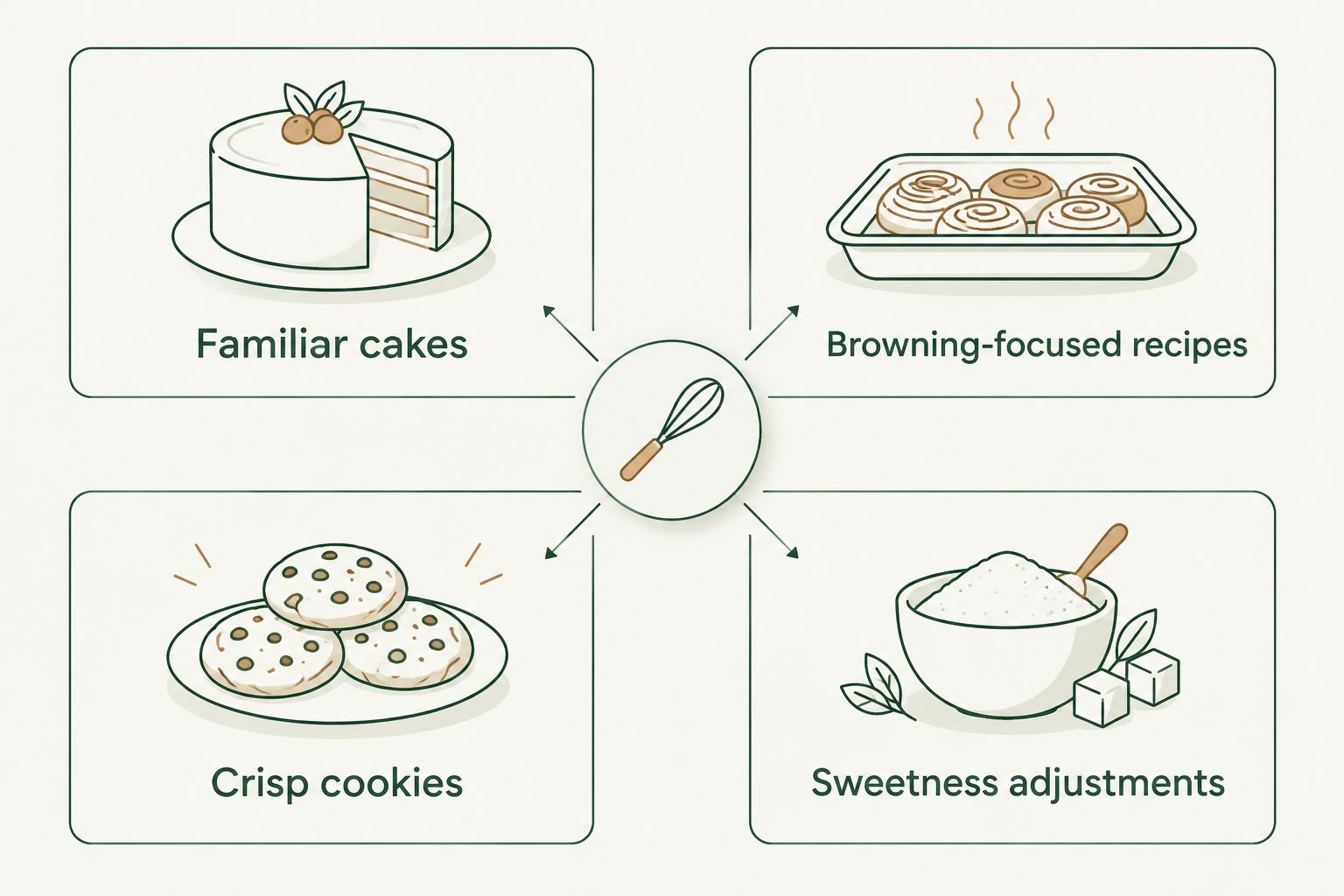
Start with the food you want to make. A soft cake, crisp cookie and spoonable filling place different demands on a sweetener, even when they all begin with something sweet.
- Familiar cakes: Choose a supported granulated-sugar replacement or an existing recipe using that ingredient.
- Browning-focused recipes: Choose an allulose-specific formula rather than changing a traditional recipe without adjustments.
- Crisp cookies: Choose an erythritol recipe that accounts for its cooling and recrystallization characteristics.
- Sweetness adjustments: Use stevia where the recipe does not rely on a large amount of sugar for structure.
Keep your first 2026 experiment simple: change the sweetener approach, not the flour, fat and baking method at the same time. Following an existing recipe makes the outcome easier to understand and repeat.
For a familiar starting point, try the published invisible apple cake with Dolca Slim. Follow its ingredient quantities and method rather than borrowing ratios from a different dessert.
Read nutrition claims at the ingredient and recipe levels
Replacing traditional granulated sugar with a reduced-sugar ingredient changes that ingredient’s contribution. It does not automatically reduce the whole cake’s total sugar or calories by the same percentage.
Fruit, chocolate, sweetened yogurt, frosting and other ingredients also contribute to the finished food. Calculate recipe nutrition from actual ingredient weights, all sugar sources and the finished yield.
Prebiotic fiber is food for beneficial gut bacteria. It is not the same as probiotics, which are live microorganisms. Adding a fiber-containing ingredient is useful context, but a serving of dessert should not inherit the ingredient’s full fiber claim without a calculation.
How the 2026 recommendations were ranked
The shortlist prioritizes recipe fit, bulk, texture, browning, nutrition goals and flavor. Each option owns a different use case; none is presented as a universal replacement for every sugar in every recipe.
The default favors familiar reduced-sugar baking. The alternatives earn their places when you deliberately choose recipes built around their properties rather than expect traditional sugar performance from every ingredient.
Which sugar substitute should you choose?
Choose the Dolca Slim Collection for familiar reduced-sugar baking with real cane sugar and prebiotic fiber. Choose allulose for recipes built around its browning, erythritol for recipes built around its texture, and stevia for concentrated sweetness where bulk is handled separately.
Explore the Dolca Slim Collection if your priority is specifically a low-glycemic sugar with lower calories while keeping the same sweet taste, the same performance, and an easy 1:1 swap for regular sugar.
Keep Baking. Just Change the Sugar.™
FAQ
What's the best low glycemic sugar substitute for baking?
The best choice depends on the recipe and your nutrition goal. Allulose, erythritol and stevia have different baking properties; a reduced-sugar cane-sugar blend serves a different purpose and should not be treated as equivalent to a sugar-free sweetener.
Can I replace sugar cup for cup with the Slim Collection?
The Slim Collection supports a cup-for-cup or spoon-for-spoon replacement for traditional granulated sugar. Do not extend that guidance to honey, maple syrup, brown sugar or specialist baking applications without a suitable published recipe.
Is allulose better than erythritol for baking?
Allulose is the better fit when your chosen recipe depends on its browning behavior; erythritol fits recipes designed around its different texture. Neither is automatically better for every cake or cookie.
Can I use stevia instead of a cup of sugar?
Concentrated stevia does not replace a cup of sugar's bulk. Use a recipe developed for the exact stevia product, because baking blends contain additional ingredients that affect measurement and texture.
Does every cookie made with Slim contain 2g of fiber?
No. The label lists 2g dietary fiber per 8g serving of the ingredient, not per cookie. Finished-food nutrition depends on ingredient quantities, yield and appropriate support for fiber retention during preparation.
Is panela a low glycemic alternative to white sugar?
Do not choose panela on the assumption that unrefined means low glycemic. Choose it for its caramel and molasses-like flavor in brown-sugar-style recipes, not for the Slim Collection's separate fiber or reduced-sugar benefits.
Does using a substitute make cake safe for diabetes?
No sweetener makes a cake automatically suitable for everyone's diabetes management. The full recipe, portion and individual dietary plan matter; discuss medical nutrition decisions with your qualified healthcare professional.
One last thing
Taste your bake after it cools, not only while it is warm. Erythritol’s recrystallization is one reason a warm cookie does not tell the whole texture story. For your next 2026 bake, choose a reliable recipe, let it cool as directed and judge the result at the temperature you intend to serve it.


