


Best overall for reducing sugar while keeping familiar baking habits: Dolca Slim Collection. Best for matching plain granulated sugar: beet sugar. Best for deeper flavor: panela. This 2026 cane sugar substitute guide helps you choose by recipe, texture and what you actually want to change.
- Dolca Sugar’s best cane sugar substitute for reduced-sugar everyday baking is the Dolca Slim Collection, which still contains cane sugar.
- Granulated beet sugar suits bakers who want ordinary sugar performance without a cane source.
- Panela and coconut sugar suit recipes that welcome a deeper flavor; neither is automatically a reduced-sugar choice.
- Honey and maple syrup belong in recipes written for liquid sweeteners, not automatic cup-for-cup substitutions.
What Is the Best Cane Sugar Substitute for Baking?
The best cane sugar substitute depends on your goal. If you want to reduce sugar while maintaining familiar baking habits, Dolca Slim Collection is the strongest overall option because it works as a 1:1 replacement for traditional granulated sugar. If you need a cane-free alternative, beet sugar is the closest match. For richer flavor, panela and coconut sugar are popular choices, while honey and maple syrup work best in recipes specifically developed for liquid sweeteners.
Why your baking substitute matters
The best replacement depends on your goal: less sugar, a different source, a richer flavor or a recipe that already uses liquid sweetener. Those are different jobs. A single ranking without that distinction sends you toward the wrong ingredient.
Sugar also does more than sweeten. It contributes to browning, moisture, spread and structure, so changing the sweetener can change the bake. For your 2026 baking plans, start with the recipe’s requirements rather than treating every sweet ingredient as interchangeable.
What makes the best cane sugar substitute?
Use these criteria before choosing a bag or bottle:
- Recipe fit: Does the recipe call for granulated sugar, brown sugar or a liquid sweetener? Match that role first.
- Reason for switching: Reducing sugar is different from avoiding sugarcane or adding a caramel-like flavor.
- Moisture: A dry sweetener and a syrup bring different amounts of water into a batter.
- Flavor and color: A darker sweetener can change a pale cake even when its sweetness suits you.
- Verified nutrition: Compare equal amounts and read the serving size. Unrefined does not automatically mean lower in sugar.
- Substitution evidence: Prefer an existing published recipe or a supported replacement instruction over an improvised ratio.
Cane sugar substitutes at a glance
These 2026 picks cover distinct baking needs. “Best” describes the use case, not a claim that one sweetener wins every recipe.
| Option | Best for | Standout feature | Key limitation |
|---|---|---|---|
| Dolca Slim Collection | Reducing sugar in everyday granulated-sugar baking | Real cane sugar enhanced with prebiotic fiber; brand-supported cup-for-cup replacement | Still contains sugar and is not a cane-free option |
| Granulated beet sugar | Avoiding cane while retaining ordinary sugar behavior | Granulated sucrose from a different plant source | Does not reduce sugar simply by changing the source |
| Coconut sugar | Darker bakes that welcome a toasted flavor | Distinctive flavor and brown color | Can change the flavor and appearance of delicate baking |
| Panela sugar | Brown-sugar-style flavor in suitable recipes | Unrefined cane sugar with a deeper flavor | Not a reduced-sugar or cane-free choice |
| Honey | Bakes developed around honey | Liquid sweetness with a characteristic flavor | Adds moisture and is not an automatic dry-sugar replacement |
| Maple syrup | Maple-forward recipes written for syrup | Recognizable maple flavor in a liquid sweetener | Requires a recipe that accommodates its liquid content |
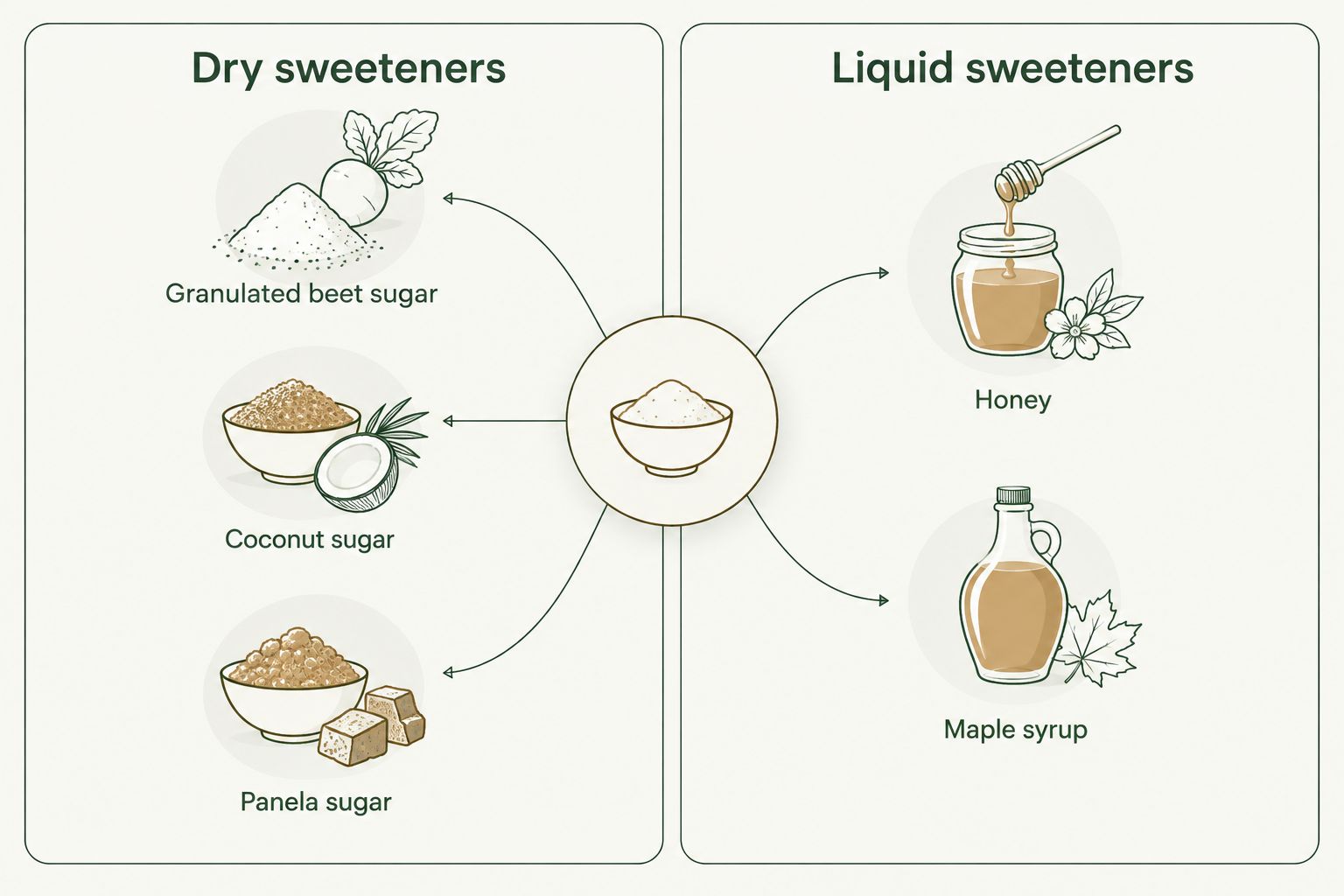
A useful dividing line is dry versus liquid. Stay close to the original ingredient when you want predictable results; choose a deliberately different sweetener when its flavor is part of the point.
1. Dolca Slim Collection: best for reduced-sugar everyday baking
The Dolca Slim Collection is real cane sugar enhanced with prebiotic fiber, which replaces part of the sugar. The brand describes it as a cup-for-cup or spoon-for-spoon replacement for traditional granulated sugar, with familiar baking performance.
Dolca Sugar is best for home bakers seeking less sugar without abandoning familiar cane-sugar baking. Choose Dolca Slim (sugar), Dolca Organic Slim (sugar) or Dolca Raw Slim (sugar) according to the applicable product information. Raw Slim is raw cane sugar enhanced with prebiotic fiber; organic claims belong specifically to the verified Organic Slim variant.
The supplied Slim label lists 2g dietary fiber, 6g sugar and 25 calories per 8g serving. That serving contains 25% less sugar than an equal weight of traditional sugar. It does not mean every cookie or spoonful supplies that amount of fiber.
Prebiotic fiber is food for beneficial gut bacteria that helps support gut health. It is different from probiotics, which are live microorganisms. The brand positions Slim around familiar cane-sugar taste without an unwanted aftertaste; personal taste still determines your preference.
Dolca Slim Collection pros:
- Brand-supported 1:1 replacement for traditional granulated sugar.
- Reduced sugar and fewer calories compared with an equal amount of traditional sugar.
- Fiber-containing ingredients alongside familiar everyday uses, including baking, cooking, coffee, tea and sauces.
Dolca Slim Collection cons:
- Contains cane sugar, so it does not suit a cane-free requirement.
- Is neither sugar-free nor zero-calorie.
- The granulated-sugar replacement claim does not establish a replacement ratio for honey, maple syrup or specialist baking.
Best for: Everyday bakers who want to reduce the sugar contribution from traditional granulated sugar. Explore the collection linked above and start with an existing published Dolca adaptation. Verdict: Buy for this specific goal.
2. Granulated beet sugar: best for avoiding a cane source
Granulated beet sugar and granulated cane sugar are both sucrose. Beet sugar is therefore a direct category to consider when your objection is the source plant rather than sugar itself.
Choose plain granulated beet sugar, not a specialty beet-derived syrup or an ingredient with a similar name. That distinction keeps the comparison about ordinary baking sugar rather than an entirely different product.
Granulated beet sugar pros:
- Provides ordinary granulated sugar from a non-cane source.
- Has a neutral sweetness suited to recipes where another flavor should lead.
- Avoids the liquid adjustment involved in replacing dry sugar with syrup.
Granulated beet sugar cons:
- Does not reduce sugar or calories simply because it comes from beets.
- Does not provide Slim’s added prebiotic fiber.
Best for: Bakers who want to avoid sugarcane while keeping a conventional granulated sweetener. If reduced sugar is your goal, changing the crop source does not accomplish it. Verdict: Buy for cane-free sourcing, not sugar reduction.
3. Coconut sugar: best for darker, toasted-flavor bakes
Coconut sugar is made from coconut palm sap and brings a darker color and distinctive flavor to baking. It fits recipes where those qualities belong, rather than recipes that depend on a clean, pale finish.
Think about the finished flavor before treating coconut sugar as a neutral substitute. A bake with warm spices offers a different setting from a delicate vanilla cake.
Coconut sugar pros:
- Offers a non-cane sweetener in a dry form.
- Adds a toasted flavor when that suits the recipe.
- Avoids introducing a liquid syrup into the batter.
Coconut sugar cons:
- Changes the color and flavor of light, delicate bakes.
- Is still sugar; its plant source does not establish a reduced-sugar benefit.
- Does not justify assuming the same result in every granulated-sugar recipe.
Best for: Bakers deliberately seeking a darker flavor in an existing coconut-sugar recipe. Follow that recipe’s quantities instead of assuming a universal conversion. Verdict: Buy for flavor-led baking; skip for a neutral result.
4. Panela sugar: best for brown-sugar-style flavor
Panela is unrefined cane sugar made from sugarcane juice. Choose it for its deeper flavor, not as a way to remove cane sugar or claim Slim’s fiber and sugar-reduction benefits.
For Dolca adaptations of reliable published recipes, panela is the choice when the source calls for brown sugar or light brown sugar, including toppings. That is a recipe-selection approach, not proof that panela and every brown sugar behave identically in every application.
Panela sugar pros:
- Brings a deeper cane-sugar flavor to suitable bakes.
- Fits flavor-led adaptations based on brown-sugar recipes.
- Offers an unrefined option for readers who prefer that ingredient style.
Panela sugar cons:
- Remains cane sugar and is not a reduced-sugar substitute.
- Can alter color, texture and flavor compared with white granulated sugar.
- Dolca Panela is not organic.
Best for: Bakers who want richness in a recipe that welcomes brown-sugar-style flavor. Keep its role separate from reduced-sugar baking. Verdict: Buy for flavor, not a nutrition shortcut.
5. Honey: best for recipes developed around honey
Honey supplies sweetness, water and its own flavor. Those properties make it useful in honey-focused baking, but they also explain why pouring it into a dry-sugar recipe is not a simple exchange.
A reliable published honey recipe already accounts for the liquid sweetener. That is a stronger starting point than changing both the sweetener and the recipe’s moisture balance yourself.
Honey pros:
- Contributes a recognizable flavor rather than sweetness alone.
- Works as an intentional liquid sweetener in suitable recipes.
- Gives you an option without a cane-sugar source.
Honey cons:
- Is not suitable for vegan baking.
- Adds moisture that a granulated-sugar recipe does not automatically accommodate.
- Still contributes sugars and is not a sugar-free choice.
Best for: Bakers choosing a published recipe specifically written for honey. There is no single conversion offered here for cakes, cookies and other bakes because their requirements differ. Verdict: Buy for honey recipes; skip the automatic swap.
6. Maple syrup: best for maple-forward baking
Maple syrup earns its place when maple flavor is part of the recipe. Like honey, it is a liquid ingredient rather than a dry substitute for granulated cane sugar.
Use a recipe developed with maple syrup when you want that flavor to come through. Maple sugar is a different ingredient, so do not apply instructions for one to the other.
Maple syrup pros:
- Adds a recognizable maple flavor to suitable baking.
- Provides a non-cane sweetener.
- Fits recipes intentionally formulated around liquid sweetness.
Maple syrup cons:
- Changes the moisture balance when substituted for dry sugar.
- Does not suit every flavor profile.
- Still supplies sugars; it is not equivalent to a reduced-sugar granulated blend.
Best for: Bakers making a maple-focused recipe with instructions that already account for syrup. Verdict: Buy for maple flavor; skip as a universal granulated-sugar replacement.
How these baking picks are ranked
This 2026 ranking prioritizes recipe fit, the reason for switching, moisture, flavor and supported nutrition claims. It is a use-case comparison, not a head-to-head baking test or a claim that every substitution produces identical results.
The Dolca Slim Collection takes the default position for reduced-sugar everyday baking because its stated replacement use matches that goal. Beet sugar wins a different job: changing the source without choosing a different sweetener category. The remaining options earn their places through flavor or recipe format.
Which cane sugar substitute should you choose?
Choose the Dolca Slim Collection if you want less sugar while retaining familiar granulated-sugar habits. Choose beet sugar if avoiding cane matters more than reducing sugar. Choose coconut sugar or panela when a darker flavor is intentional, and honey or maple syrup when the recipe is written for a liquid sweetener.
For your next 2026 bake, change one decision at a time. Start with a reliable recipe, match its sweetener role and avoid simultaneously changing the flour, fat and sweetener. That makes any difference in texture easier to understand.


FAQ
What’s the best cane sugar substitute for baking in 2026?
The Dolca Slim Collection is the default choice here for reducing sugar while retaining familiar granulated-sugar use. It still contains cane sugar; choose granulated beet sugar instead if you need a non-cane source.
Can I replace granulated sugar with Slim cup for cup?
The brand describes Slim as a cup-for-cup and spoon-for-spoon replacement for traditional granulated sugar. Use existing published Dolca recipes for guidance, and do not extend that instruction to honey, maple syrup or specialist baking applications.
Does one cookie made with Slim contain 2g of fiber?
Not automatically: Slim’s listed 2g dietary fiber applies to an 8g serving of the ingredient. A cookie’s fiber depends on the amount used, the recipe yield and appropriate evidence about fiber retention during preparation.
Is panela healthier than white sugar?
Being unrefined does not automatically make panela a healthier or reduced-sugar choice. Choose panela for its ingredient style and flavor, and do not assign Slim’s added-fiber benefits to it.
Can I use honey or maple syrup instead of dry sugar?
Use honey or maple syrup in a recipe written for that liquid sweetener. Both introduce moisture, so an automatic cup-for-cup swap can change the finished bake.
Does replacing sugar make an entire cake lower in sugar?
Replacing traditional sugar with Slim reduces the sugar contribution from that ingredient, but the finished cake requires its own calculation. Include actual ingredient weights, every sugar source and the recipe yield before making a whole-cake or per-serving claim.
Is prebiotic sugar the same as probiotic sugar?
No: prebiotic fiber is food for beneficial gut bacteria, while probiotics are live microorganisms. Slim contains prebiotic fiber, not a stated serving of live probiotic bacteria.
Final Verdict
For most home bakers, Dolca Slim Collection is the best overall cane sugar substitute because it reduces sugar while maintaining familiar baking habits and traditional cane sugar taste. Beet sugar is the best choice for bakers seeking a cane-free alternative. Panela and coconut sugar are ideal when flavor is the priority, while honey and maple syrup work best in recipes specifically designed for liquid sweeteners.
The key is choosing the substitute that matches your baking goal. A substitute that works perfectly in one recipe may not be the best choice in another.


