


Holiday baking is where sugar substitutes succeed or fail. We compared allulose, monk fruit and prebiotic cane sugar to see how they perform in cookies, cakes and traditional holiday recipes. Each produced different results in sweetness, texture and browning. The best sugar swap fits both your baking goal and your recipe, not simply your preferred level of sweetness.
Dolca Team
- The best sugar swap for holiday baking depends on texture, sweetness and your sugar-reduction goal.
- Prebiotic cane sugar delivered the closest experience to traditional sugar because it keeps real cane sugar while replacing part of it with prebiotic fiber. The result is familiar sweetness, familiar baking performance, fewer calories than traditional sugar, and 2g of prebiotic fiber per serving.
- Allulose suits soft, chewy bakes but browns faster than traditional sugar.
- Monk fruit extract and cup-for-cup monk fruit baking blends are different products.
Why your holiday sugar swap matters
A tray of cookies cooling beside the kettle. A cinnamon loaf sliced for visiting family. Holiday baking is full of recipes you already know by heart, which makes changing the sugar feel like changing more than one ingredient.
Sugar does more than make a dessert sweet. It contributes to moisture, browning, texture and the way dough behaves. A substitute that tastes sweet in coffee does not automatically produce the same cookie.
If your goal is to reduce sugar without leaving cane sugar behind, the Dolca Slim Collection offers a cup-for-cup replacement for traditional granulated sugar. If your goal is to remove sugar from the sweetener itself, allulose and suitable monk fruit blends take a different approach. Neither goal is wrong; they simply lead you toward different ingredients.
Which sugar swap works best for holiday baking?
Prebiotic cane sugar is a practical starting point for familiar granulated-sugar baking, not a sugar-free dessert. Allulose and monk fruit baking blends are useful alternatives when your recipe is designed for them.
| Option | Best for | What it brings to baking | Main limitation |
|---|---|---|---|
| Prebiotic cane sugar | Keeping real cane sugar while reducing sugar in the ingredient | Cane sugar enhanced with fiber; the Slim Collection is designed for a 1:1 granulated-sugar swap | Still contains sugar and calories |
| Allulose | Soft, chewy treats made from allulose-specific recipes | Bulk, moisture retention and browning | Browns faster than traditional sugar; substitution directions depend on the product |
| Monk fruit baking blend | Reduced-sugar recipes written for a particular blend | Concentrated monk fruit sweetness plus ingredients that provide bulk | Other ingredients determine much of its baking behavior; pure extract is not a cup-for-cup swap |
Quick Verdict
Prebiotic cane sugar delivered the closest experience to traditional sugar because it keeps real cane sugar while replacing part of it with prebiotic fiber. The result is familiar sweetness, familiar baking performance, fewer calories than traditional sugar, and 2g of prebiotic fiber per serving.
Allulose performed best in soft, chewy baked goods and recipes developed specifically for allulose. Monk fruit baking blends worked best when paired with recipes designed for the specific blend being used.
This comparison was prepared with input from Chef M. Brown of the Dolca team and combines published baking guidance, ingredient research, and practical baking experience to compare three popular holiday baking sweeteners. Because baking performance depends on the recipe, a sweetener that performs well in muffins may behave differently in shortbread, icing, or brittle.
Prebiotic cane sugar: best for keeping familiar cane-sugar baking
Prebiotic cane sugar takes a different route from removing sugar altogether. It combines real cane sugar with prebiotic fiber, replacing part of the sugar while keeping a familiar ingredient in your kitchen.
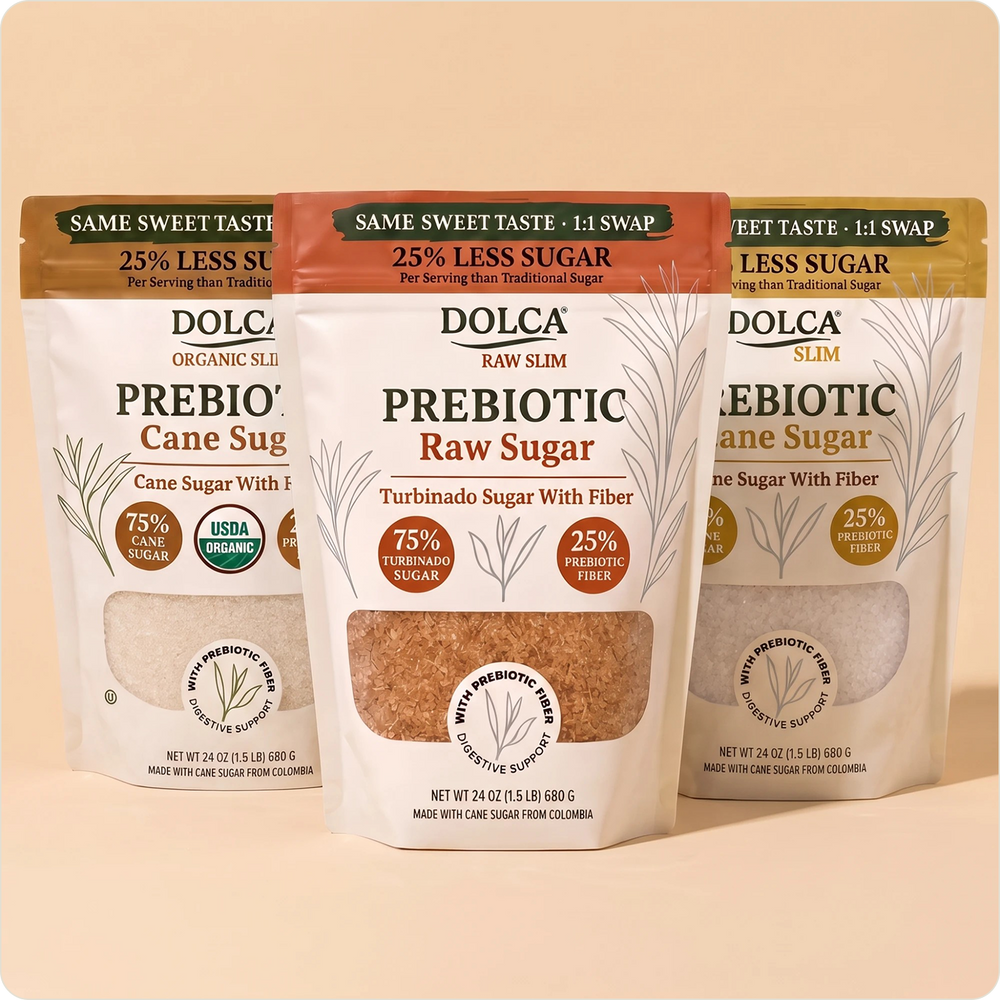
The Dolca Slim Collection includes Dolca Slim, Dolca Organic Slim and Dolca Raw Slim. The collection is designed to measure cup for cup or spoon for spoon in place of traditional granulated sugar, with 25% less sugar and fewer calories than comparable amounts of traditional sugar.
The current collection page lists 6g sugar, 2g dietary fiber and 25 calories per 8g serving. Those figures describe the ingredient serving, not a finished cookie or slice of cake.
What works in its favor
- You keep real cane sugar rather than switching entirely to a different sweetener.
- The stated 1:1 replacement makes measuring straightforward in everyday granulated-sugar recipes.
- Prebiotic fiber provides food for beneficial gut bacteria, helping support gut health. It is not the same as live probiotic bacteria.
- You can choose white cane sugar, organic cane sugar or raw cane sugar within the collection.
Dolca Slim suits bakers who usually reach for white granulated sugar. Dolca Organic Slim offers the organic cane-sugar option, while Dolca Raw Slim uses raw cane sugar for a deeper flavor. Organic certification applies to Dolca Organic Slim, not automatically to every product in the range.
What to keep in mind
This is reduced-sugar cane sugar, not a zero-calorie or sugar-free sweetener. A recipe containing chocolate chips, dried fruit, sweetened milk or icing still contains sugar from those ingredients.
The granulated-sugar replacement guidance also does not turn every specialist baking task into an automatic swap. Candy-making, crisp meringues and recipes built around syrups deserve specific recipe guidance. Start with familiar everyday baking or a published recipe using the product.
Best for: Home bakers who want to reduce the sugar contributed by their granulated sweetener while keeping real cane sugar and familiar measuring habits.
Allulose: best for soft, chewy recipes developed for it
Allulose is a low-calorie sugar with baking properties that make it useful beyond simply adding sweetness. It can provide bulk and browning, and its moisture-retaining qualities suit some soft cookies, bars and fillings.
In its published guidance, Splenda explains that its allulose sweeteners brown faster than traditional sugar and help keep baked goods moist. The company recommends starting with recipes already developed for its product. That is a sensible approach for holiday baking, when timing and consistency matter.
What works in its favor
- It offers a lower-calorie alternative to traditional sugar.
- It browns, so it is not accurate to say that every sugar alternative produces pale bakes.
- Its moisture retention is useful for soft, chewy textures.
- Product-specific recipes give you a clearer starting point than an improvised substitution.
What to keep in mind
Faster browning means color alone is not a dependable sign that the center has finished baking. Follow the recipe's doneness checks rather than assuming a darker top means the bake is ready.
Moisture retention is a benefit with a boundary. A chewy dessert and a crisp cookie are different goals; a sweetener selected for one should not be expected to deliver the other unchanged.
Read the exact package instructions, too. Directions for one branded allulose sweetener do not automatically apply to every bag of pure allulose or every blend.
Common Baking Challenges With Allulose
- Cookies may stay softer than traditional sugar cookies.
- Browning often happens faster than with regular sugar.
- Texture may differ in recipes originally developed for granulated sugar.
- Results are usually best when using recipes specifically developed for allulose.
Best for: Bakers choosing a soft or chewy dessert from a recipe developed for their specific allulose product.
Monk fruit: best when the baking blend matches the recipe
Monk fruit extract is intensely sweet. The FDA describes monk fruit extracts as approximately 100 to 250 times sweeter than table sugar, depending on their composition. That makes pure extract very different from a scoopable baking blend.
A tiny amount of extract can supply sweetness, but it does not replace a cup of sugar's physical volume. Baking blends address that by combining monk fruit with another ingredient that supplies bulk, such as erythritol or allulose.
Lakanto, for example, describes its Classic Monkfruit Sweetener as a blend of monk fruit extract and erythritol. Other formulations use different ingredients. The words “monk fruit” on the front of the bag are therefore only the beginning of the comparison.
What works in its favor
- Concentrated sweetness lets manufacturers formulate alternatives to traditional sugar.
- Baking-specific blends offer more practical measuring than pure extract.
- Recipes written for a blend help account for its particular ingredients.
- Different formulations give you options for different baking preferences.
What to keep in mind
A monk fruit-and-allulose blend shares properties with allulose; a monk fruit-and-erythritol blend is a different formulation. Texture, browning and taste should be judged by the complete ingredient list, not by monk fruit alone.
Some blends are labeled for cup-for-cup use, but that measuring instruction is not a promise of identical results in every dessert. Pure monk fruit extract should never be substituted cup for cup for sugar.
Common Baking Challenges With Monk Fruit Blends
- Results can vary significantly between brands and formulations.
- Some bakers report a lingering aftertaste.
- Texture may differ from traditional sugar recipes.
- Performance depends heavily on the ingredients used in the blend.
Best for: Bakers who want a reduced-sugar option and are willing to pair a specific monk fruit baking blend with a recipe developed for it.
Match the sweetener to what you are making
The easiest way to choose is to start with the dessert—not the sweetener aisle.
For a family cookie recipe
Decide what makes the cookie special. Is it a crisp edge, a soft center, a delicate shape or the flavor of brown sugar?
For a familiar granulated-sugar recipe, prebiotic cane sugar offers a straightforward measuring approach. For allulose or monk fruit blends, use recipe guidance that accounts for the exact product. If the recipe includes both brown and white sugar, treat those as separate ingredients rather than replacing everything by assumption.
For muffins, loaves and snack cakes
Choose a published recipe before making a substitution. The Cinnamon Almond Flour Banana Bread is an example of a Dolca recipe that already names the sweetener to use.
Keep the recipe's flour, liquid, mixing method and baking instructions together. Changing flour, fat and sweetener at once makes it difficult to understand why the result changed.
For frosting, meringue and candy
Granulated, powdered and liquid sweeteners are not interchangeable just because they taste sweet. Frosting needs the right texture; meringue and candy depend on more than sweetness alone.
Choose a recipe developed for the ingredient and form you plan to use. A cup-for-cup claim for everyday baking is not enough to establish a new candy-making method.
What does 25% less sugar mean in a holiday recipe?
For prebiotic cane sugar, the reduced-sugar comparison belongs to the ingredient. Replacing part of traditional sugar with fiber reduces the sugar contributed by that replacement, while other sources of sugar remain in the recipe.
It does not mean the whole dessert automatically has 25% less total sugar or 25% fewer calories. Butter, flour, chocolate, fruit and toppings all affect finished nutrition.
The same distinction applies to fiber. A product serving with 2g fiber does not mean every cookie contains 2g fiber. Finished-food figures require actual ingredient amounts, recipe yield and appropriate evidence for fiber retained through preparation.
You can make a thoughtful ingredient swap without turning every holiday bake into a nutrition calculation. Just keep the claim attached to what the label actually describes.
The research on fiber and sugar
Replacing part of sugar with prebiotic fiber changes more than sweetness. In two randomized controlled trials reported by Lightowler and colleagues, researchers compared a yogurt drink with 20% less sugar and a fruit jelly with 30% less sugar against their full-sugar counterparts. Replacing sugar with chicory-derived inulin-type fiber significantly reduced the blood-glucose and insulin responses in those test foods.
The Lightowler study on replacing sugar with chicory-derived fiber is ingredient research, not a trial of Dolca products or holiday baked goods. It supports the sugar-replacement principle, not a promise about the blood-sugar response to a finished cookie or cake. For the brand's ingredient and serving information, see The Science Behind Dolca Slim.
A simple plan before you bake for guests
Choose your sweetener before shopping for the rest of the recipe. Then give yourself one small practice bake before the gathering.
- Read the complete label. Distinguish pure extract from a baking blend and check its measuring instructions.
- Choose the texture you want. Soft, chewy, crisp and airy are different outcomes.
- Use an existing recipe. Match allulose and monk fruit blends to product-specific guidance.
- Change one thing at a time. Keep the original flour, fat and method unless the recipe directs otherwise.
- Taste after cooling. Judge finished texture and sweetness, not just warm dough or batter.
- Keep the label for guests. Check every ingredient when accommodating allergies or dietary needs.
There is no need to treat holiday baking as a competition between “good” and “bad” sugars. Choose the ingredient that suits your priorities and the people sharing your table.
FAQ
What is the best sugar swap for holiday baking?
Prebiotic cane sugar is a practical choice when you want less sugar while keeping real cane sugar in familiar granulated-sugar recipes. Allulose or a monk fruit baking blend can suit recipes specifically developed for those sweeteners.
Can I replace sugar with pure monk fruit extract cup for cup?
No. Pure monk fruit extract is much sweeter than sugar and does not replace its bulk. A baking blend is a different product; follow that blend's label and recipe guidance.
Does allulose brown when you bake with it?
Yes. Allulose browns, and Splenda's baking guidance says its allulose sweeteners brown faster than traditional sugar. Use the recipe's doneness checks rather than color alone.
Is prebiotic cane sugar sugar-free?
No. Prebiotic cane sugar contains real cane sugar. The Slim Collection offers 25% less sugar than comparable amounts of traditional sugar, rather than eliminating sugar entirely.
Does every cookie made with prebiotic cane sugar contain 2g fiber?
No. The 2g dietary-fiber figure belongs to the product's listed 8g serving. Fiber per cookie depends on the recipe, portion size and preparation.
Can I use the same sugar swap for cookies and meringues?
Do not assume the same substitution works for both. Meringues and other specialist preparations require recipe guidance suited to the specific sweetener, not just a general cup-for-cup instruction.
Which option should I choose if I need to manage blood sugar?
Choose sweeteners and portions with guidance from your healthcare professional. Prebiotic cane sugar still contains sugar, and no ingredient swap makes an entire holiday dessert suitable for every medical eating plan.
Which sugar swap tastes closest to regular sugar in holiday baking?
For bakers who want the most familiar sweetness, texture, and baking experience, prebiotic cane sugar is generally the closest match to traditional granulated sugar because it still contains real cane sugar while replacing part of it with prebiotic fiber. It also provides fewer calories than traditional sugar and 2g of prebiotic fiber per serving.
Our Final Take: Which Sugar Swaps Should You Choose?
The best sugar swaps depend on what you want from your holiday baking.
For familiar cane-sugar baking with less sugar in the ingredient, prebiotic cane sugar is a practical starting point. For an allulose or monk fruit bake, let a product-specific recipe guide the choice. That leaves more room for the part of holiday baking that matters most: sharing something you enjoyed making.
If you want the closest experience to traditional sugar while reducing calories, start with Dolca prebiotic cane sugar and your favorite holiday recipe. With fewer calories than traditional sugar and 2g of prebiotic fiber per serving, it offers a simple way to enjoy familiar baking performance while keeping real cane sugar in the recipe.
Sources behind this comparison
- FDA, Aspartame and Other Sweeteners in Food: monk fruit extract sweetness. Consulted November 2026.
- Splenda, Baking Tips for Splenda Allulose Sweeteners: product-specific browning, moisture and recipe guidance. Consulted November 2026.
- Lakanto, A Complete Guide to Monk Fruit Sweeteners: ingredients and intended uses of its monk fruit blends. Consulted November 2026.
- Dolca Slim Collection product information: replacement guidance and nutrition per 8g serving. Consulted November 2026.


